AP European History Guide
A comprehensive study tool for acing European history and getting a 5 on your exam
Interwar Period, and WWII to post-Cold War
Era of Good Feeling
Topics:
- The Spirit of Locarno
- Revolutions: Double Trouble
- Twentieth Century Culture
- The Retreat from Democracy
World War II & The Cold War
Topics:
- Global War
- The Road to Recovery
- The Cold War
The Spirit of Locarno
Russia and Italy morph into totalitarian states, but Germany does not collapse—it’s actually on the road to recovery
1. Partnership between Gustav Stresseman (the foreign minister of Germany appointed in 1923) and Aristide Briand (started 1925)
- 1925 Locarno Treaty of free will
- Germany permanently recognizes French borders in the west (Alsace-Lorraine, Rhineland)
- Oath never to change borders in the east (Polish Corridor) by force
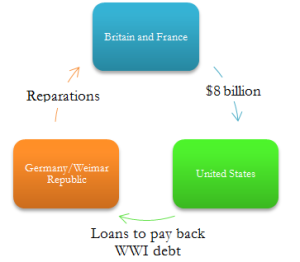
- Mortgage for reparations (Dawes plan)
2. Germany enters the League of Nations in 1926
- 1928 Kellogg-Briand Pact which outlaws war. Every country besides Russia and Italy sign it. Totally idealistic, carries such little meaning. It’s almost like the world is in denial and its telling itself things are going to be okay.
Then in October 1929… disaster.
– The Great Depression hits, now U.S. can’t help Germany pay reparations, ends the cycle of payments
– Stresseman dies (and there goes yet another chance to stop Hitler)
– Young Plan of 1929—France leaves the Rhineland and German payments are scaled back. Two months later, Hitler comes.
– Briand dies in 1932
Revolutions: Double Trouble
THE RUSSIAN REVOLUTION
The Russian revolution is rooted in the country’s history. The reign of the Mongols ended when Ivan took over and centralized the government, creating a consolidated authoritarian social structure. By the seventeenth century, most peasants were serfs. Agriculture and limited industrial development were controlled by the czar, and depicted western ideas as a corrupting influence. After the Decembrist coup, Nicholas I was isolated in the Winter Palace. He hated revolutionaries. Tolstoy, Pushkin, Dostoevsky—virtually unknown to the Russian people, since the press was censored. However his son, Alexander, follows a new policy of trickle-down politics (Roosevelt used this). His reign included…
- A state bank
- No peasant response to idealists
- Anti-semitic pogroms
- Growth of proletariat with existing aristocrats
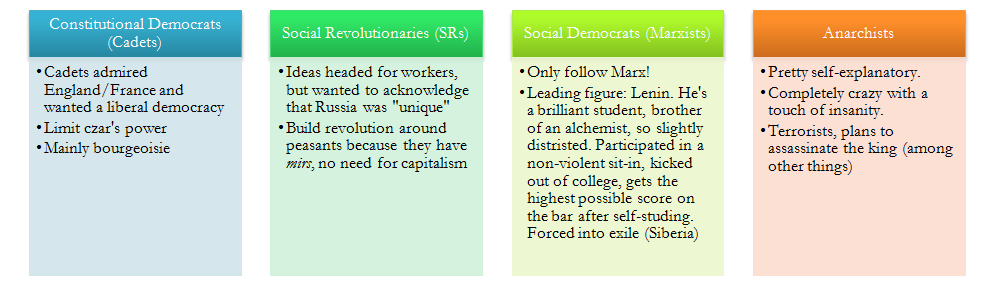
In 1898, George Plekhanov founds the Social Democratic Party, but it’s quickly taken over by Vladimir Ilyich (aka Lenin). He’s arrested for being a revolutionary, but he escapes later on. The SDP was divided into two Communist factions: the Bolsheviks and the Mensheviks.
When Nicholas II (1894-1917) takes over (the very last czar of Russia), there are many anti-czar campaigns that include…
So, Vladimir Ilyich Ulyanov becomes Lenin!
The Bolsheviks and Mensheviks
Lenin decides Marx is wrong, and understands that there doesn’t have to be collective class consciousness, because the workers are easy to buy off. You need a vanguard—a small group of dedicated revolutionaries.
Under the principles of a dialectic, a group disagrees with this, and that becomes the Mensheviks—they want a large party that works under the current structure to find common ground with the SRs and Cadets. They want capitalism first.
There is an attempt to unify the two groups in 1903, in Brussels, Belgium. Completely fails.
Pre-War Russia
War → inflation → Bloody Sunday. Workers go on strike, peasants start to take land, so the czar agrees to have a Duma. The Mensheviks create a worker’s union known as a Soviet, and the St. Petersburg Soviet announces a general strike. The October Manifesto and Fundamental Laws are published, but the czar dissolves the Duma in July.
Peter Stolypin reforms Russia by implementing conservative policies—he first breaks up the mirs, ending peasant debts, then wipes out most anti-czar movements.
By 1914, World War I begins. Nicholas II’s son Alexei has hemophilia, and mystic/hypnotist Grigori Rasputin comes along. He hypnotizes Alexei and needles his way into government, becoming the leading minister of Russia.
Economic and Social Crisis
Production and transportation undependable
War refugees fill roads, workers’ incomes plummet
Inflation soars
Food shortages increase (no one could get bread while the czar lived in luxury)
Pavel Milyukov, leader of the liberal Cadets, attacks the government
Alexander Kerensky, an SR, is another central figure
December: Rasputin dies
St. Petersburg becomes Petrograd
Revolution of 1917
February 23: Bread riots in the streets. Police join in, deputies form a provisional government. March revolutions overthrow the czar, giving way to the Mensheviks. In November, the Bolsheviks take over.
By March, the Duma assumes power. Elections for a constituent assembly take place, headed by Alexander Kerensky, who assumes the title of President in July. Lenin takes advantage: Germans allow him to travel back to Russia, expecting to incite revolution. Lenin publishes the April Theses, calling for peace, land, bread, and “all power to the Soviets.”
The Petrograd Soviet issues Order No. 1, giving the military total democracy and undermining the Duma. By July 1917, Lenin doesn’t think Russia is ready, but the Bolsheviks attempt a bid for power. They are crushed; Lenin escapes to Finland.
August: General Kornilov attempts a coup. The Mensheviks release Bolsheviks from jail to help defeat Kornilov. Unfortunately, the Bolsheviks then take over in November, seizing key buildings with 6,000 supporters. Elections are held, but they don’t win. In January 1918, the assembly meets, and Lenin abolishes all parties besides the Bolsheviks.
Bolsheviks → Communist Party
Russia → USSR (Soviets)
Red-White Civil War (1918-1921)
Essentially, Leon Trotsky versus everyone else. Reds win because:
Control of main cities/ports
Gives away White land at Brest-Litovsk to Germans
Trotsky is a brilliant Marxist (almost like an Oliver Cromwell) but he’s NOT a Bolshevik. He initially opposes Lenin.
War Communism
People take over unused land but must give crops to the government
Red Terror: about one million peasants killed
Cheka (secret police) established
Bolshevik victory in Crimea ends the war
By 1921: Industry at 20% pre-war level, agriculture production halved.
NEP (New Economic Policy) allows private ownership, creating a new class of Kulaks (rich peasants). By 1923, Russia begins recovery.
Politburo
Vladimir Lenin (1870-1924) – Leader
Leon Trotsky (1879-1940) – War & Foreign Minister
Gregory Zinoviev (1883-1936) – Head of International Bureau & Comintern
Lev Kamanev (1883-1936) – Deputy Chief of Staff
Nikolai Bukharin (1888-1953) – Press, propaganda, NEP proponent
Joseph Stalin (1879-1953) – Underdog; bureaucrat; as General Secretary controls appointments
By December 1922, things look good. BUT THEN! Lenin has a stroke!
March 1923: second stroke → January 1924: Lenin dies. Eerily similar to the French Revolution…
Historical Parallels
Bolsheviks/Mensheviks = Jacobins/Girondins
Temporary dictatorship
Nicholas II = Louis XVI
Huge civil war with Reign of Terror
Committee of Public Safety = Politburo
Kornilov coup = Thermidorian Reaction
Napoleon = Trotsky
Classic “pendulum” of history
After Lenin: Ideological Disputes
Cult of Personality: Lenin elevated; statues erected; Petrograd → Leningrad; body displayed against wishes
Collectivization vs. NEP: Trotsky wants Marxist communes; Bukharin supports NEP
Permanent Revolution vs. Socialism in One Country: Trotsky vs. Stalin
1925: Trotsky resigns, later expelled from Politburo
1926: Expelled from Communist Party
1927: Exiled from country, face removed from photos
1989: Russian history teacher in Greeley unaware of Trotsky
Stalin’s Rise
Blames Zinoviev & Kamanev → purged
Turns on Bukharin (1928), steals Trotsky’s ideas, city named Stalingrad
Series of Five-Year Plans: collectivization → famine kills ~10 million
Industrialization: high turnover, low output/quality
Nation mobilized: education, family, propaganda
1930s – Purge Trials
Zinoviev, Kamanev, Bukharin confess → executed
Trotsky flees Europe; assassinated in Mexico City (1940)
ITALIAN FASCISM
Although the least developed of the major powers, Italy had started to industrialize. Racked by inflation, unemployment, and talk of revolution, social conflicts that were previously ignored were brought to the surface in the country.
Fascism
Fascism comes from the Latin word fascio, or bundle—the idea is that a stick is individually weak but strong in unity. The Italian fascism movement centers around Benito Mussolini. It employs propaganda, symbols, and activism. Fascists had little electoral success at first but slowly gained seats in the Chamber as the aging prime minister, Giolitti, started to fall. Mussolini forms the Black Shirt army, which planted bombs, beat up opponents, and disrupted meetings.
Stages a March on Rome in October and moves on the capital
King Victor Emmanuel III invites him to form a cabinet; he becomes prime minister of a coalition government. By 1924, the Fascists hold a clear majority.
Mussolini gradually isolates the Socialist and Popular party, expelling opponents and killing so-called enemies of the state. Mussolini, or Il Duce, was the total leader.
“The Duce is always right” … “Believe, obey, fight.”
Domestic policies include autarchy, a self-sufficient national economy emphasizing industrialization and technology. The value of the lira is set equal to the French franc, which ultimately hurts Italian exports and leads to currency devaluation.
1926: Battle for Grain, doubling grain production at great cost in efficiency
Institute for Industrial Reconstruction established subsidies for weak industries
Suppressed mafia groups in Sicily and drained malaria-infested marshes near Rome
Family bonuses provided poor families fiscal security
New railroads and superhighways built
Mussolini arranged the Lateran Agreements of 1929, ending sixty years of conflict between church and state. It recognized Vatican City as an independent state and promised to restrict Protestant activities.
Twentieth Century Culture
Thanks to Freud, some artists and authors (like the Surrealists) used dreamlike canvases to explore the subconscious.
Marcel Proust: Remembrance of Things Past—study of upper-class Parisian life; interior monologue
Franz Kafka: wrote in German (The Trial), wanted manuscripts burned
James Joyce: Ulysses (1922)
Virginia Woolf: political activist/feminist, wrote A Room of One’s Own (1929)
Art Movements
Dada: noisy nonsense, absurd juxtapositions to anger bourgeoisie
Futurists: new art for technological age
Cubists & Expressionists: twelve-tone scale, dissonance
Main Schools of Art
Impressionism: overlapping color, blurred lines, wide brush
Edouard Manet: Luncheon on the Grass, The Bar at the Folies-Bergère
Claude Monet: Sunrise, water lilies
Auguste Renoir: Madame Charpentier and Children
Edgar Degas: ballerina paintings, asymmetry
Post-Impressionists:
Vincent Van Gogh: Starry Night, abstract self-portraits
Pointillism: George Seurat, using dots to create shaded images
Abstract Expressionism:
Henry Matisse: flattened canvases, Fauve school
Cubism:
Pablo Picasso: Les Demoiselles d’Avignon, Three Musicians
Marcel Duchamp: Nudes Descending the Staircase
Georges Braque: Woman with Guitar
Surrealists:
Salvador Dali: The Persistence of Memory, time as dimension, Freud + Einstein fusion
Science of the Twentieth Century
Advances in physics and chemistry: Niels Bohr, J.J. Thompson, Ernest Rutherford, Marie & Pierre Curie
Albert A. Michelson & Edward W. Morley: speed of light same in all directions; challenged ether theory → Einstein’s relativity
Space & time measured relative to observer → space-time continuum
Time is dependent on velocity; at speed of light, time stops
Matter transforms into energy: E=mc²
Max Planck (1902): energy released/absorbed in discrete units (quanta)
Ernest Rutherford: gold foil experiment → atom mostly empty space
Werner Heisenberg: uncertainty principle, probability in atomic behavior
Alexander Fleming & Howard Florey: penicillin
Economics of the Twentieth Century
Top economists: Karl Marx, Adam Smith, John Maynard Keynes
Keynes’ Economic Consequences of the Peace: invisible hand fails in depression → government must intervene
Regulation & low interest
“Prime the pump”: government spending
Deficit spending (New Deal style)
European Integration
1950: Germany & France form Coal/Steel Authority; Italy & Benelux join 1951
1957: Treaty of Rome → European Economic Community (EEC)
1973: Britain, Ireland, Denmark join
1979: Citizens elect EEC parliament
1981: Greece joins
1986: Spain & Portugal join → single market
1992: Maastricht Treaty → European Union & common currency (Euro)
2004: Czech Republic, Poland, Baltic states, Hungary, Slovakia join
2007: Romania & Bulgaria join
Religion
1965: Vatican II council
Mass in vernacular
Apology to Jews/exoneration for Jesus’ death
Ecumenism: non-Catholics can marry Catholics, go to heaven
Pope John Paul II: apologized to Martin Luther & Galileo, Jubilee year for Church sins
The Retreat from Democracy
By 1929, authoritarian regimes suppressed liberty across Hungary, Spain, Albania, Portugal, Lithuania, Poland, Yugoslavia, Italy
Hungary: Admiral Miklos Horthy → anti-Semitic gov eradicates democracy
Romania: King Carol II strips Jews of land/citizenship
Yugoslavia: King Alexander I tries to tame nationalism
Poland: 1926 → Marshall Jozef Pilsudski assumes power
Fascism drew attention to social problems, criticized liberalism/capitalism, leveraged parliamentary ineffectiveness
Great Depression (Oct 24, 1929): industrial production cut by third, unemployment rises, tariffs & quotas → political extremism
Hitler: Rise to Power, Nazi Germany, and Pure Terror
Adolf Hitler: Austrian, born 1889, abusive father, mother, rejected by Vienna Art Academy, served in WWI
Middle school dropout, no initial anti-Semitism
Becomes Nazi leader (National Socialist German Workers’ Party)
1923: jailed after Munich Putsch → writes Mein Kampf
Loyal followers: Hermann Göring, Joseph Goebbels, Heinrich Himmler, Ernst Röhm (SA)
Legal seizure of power; eliminates opposition, becomes Führer
Gleichschaltung: federal states lose autonomy, administrative Gaue led by Gauleiter
Unemployment drops, currency stabilized (Hjalmar Schacht)
Strikes outlawed, worker mobility regulated
Propaganda: “Strength through Joy”, anti-modern art, anti-nightlife, anti-homosexuality, strict gender roles
Nuremberg Laws (1935): banned marriage between Aryan, Jews, gypsies, etc.
Who Can We Blame?
People: Kurt von Schleicher, Franz von Papen, Paul von Hindenburg, nationalists/centrists, communists, ordinary citizens, Stalin
Events: WWI, Treaty of Versailles (too harsh, poorly enforced), Great Depression, militarism/nationalism, weakness of Weimar Republic, inexperience with democracy
World War II: Global Terror
1934
Non-Aggression Pact with Poland (January): 10-year guarantee of friendship between Germany and Poland.
Germany drops out of the League of Nations.
Vienna Putsch (July): demonstrates that treaties are only as effective as their enforcement, as Hitler repeatedly violates the Treaty of Versailles.
1935
Rearmament in March during a public speech (“Saturday Night Special”), signaling Germany’s military ambitions.
Leads to the German-British Naval Agreement (July): Germany can expand its navy to 35% of Britain’s—nullifying Versailles.
Britain accepts immediately, beginning the policy of appeasement.
France fortifies its borders (Maginot Line).
U.S. Neutrality Act passed; Italy invades Ethiopia.
1936
Remilitarization of the Rhineland (March), angering Stalin, who seeks alliances with democratic nations.
Spanish Civil War (1936–1939): Hitler supports Francisco Franco; Stalin backs the democratic republic.
Axis alliance of Rome and Berlin formed.
France does nothing when Hitler intervenes in Spain.
Another U.S. neutrality act ensures they stay out of European conflicts.
1937
Hossbach Minutes (November) reveals Hitler’s war ambitions.
Alliances with Japan and Italy formalized.
1938
Anschluss: Hitler threatens Austria unless Nazi Party restrictions are lifted; Arthur Seyss-Inquart installed as Interior Minister.
Sudetenland Crisis in Czechoslovakia: Hitler demands German-majority regions, threatening war by October 1.
Munich Conference (September 29): Hitler takes the Sudetenland; Chamberlain declares “peace for our time.”
Czechoslovakia divided into Czech and Slovak regions; USSR and Czechoslovakia not invited.
1939
Germany invades the rest of Czechoslovakia; Britain pledges to defend Poland.
Nazi-Soviet Nonaggression Pact signed to avoid a two-front war; Stalin gains parts of Poland and Baltic territories.
September: Germany attacks Poland with blitzkrieg; Soviet Union invades Finland.
1940
Germany invades Denmark, Norway, the Netherlands, and Belgium.
France falls after German forces bypass the Maginot Line; Paris captured mid-June.
Miracle of Dunkirk: 340,000 British troops evacuated.
Britain remains alone; Battle of Britain fought in the air, Churchill emerges as hero.
1941
Germany invades the Soviet Union (Operation Barbarossa) late June; delayed timing leads to massive losses at Stalingrad and failure to capture Moscow.
December: Japan attacks Pearl Harbor; U.S. declares war; Germany and Italy declare war on the U.S.
1942
Battle of Stalingrad begins.
Nazis implement the Holocaust; Final Solution planned (January 1942).
By 1945, six million Jews and millions of others killed in concentration and death camps.
1943
Axis powers pushed out of Africa; Allies invade North Africa and Sicily.
Mussolini arrested; Marshal Pietro Badoglio becomes Italian Prime Minister.
Tehran Conference (November): Soviets accept Polish borders; question of post-war government left open.
1944
Allies seize Naples (May) and Rome (June).
D-Day (June 6): 150,000 men land in Normandy; Paris liberated by August.
Last German offensive: Battle of the Bulge.
1945
Yalta Conference: United Nations formed; Germany divided into occupation zones; free elections promised in Soviet-occupied countries.
Berlin captured by Soviets; Hitler commits suicide.
Americans advance in Asia: Guam, Philippines, Iwo Jima.
Firebombing of Tokyo kills 200,000; atomic bombs dropped on Hiroshima (August 6) and Nagasaki (August 9).
Soviet Union declares war on Japan (August 8); Japan surrenders September 2.
The Road to Recovery
Total casualties: 50 million worldwide; Germany and Soviet Union hardest hit.
UNRRA (United Nations Relief and Rehabilitation Administration) created in 1943.
Nuremberg Trials prosecute Nazi war crimes.
NATO (1949) and Warsaw Pact established.
Konrad Adenauer leads German recovery; European integration advances with France and Italy.
The Cold War
Traditional view: USSR violated Yalta agreements; iron curtain divides Europe.
Truman Doctrine: U.S. supports countries resisting communism ($400 million to Greece and Turkey).
Marshall Plan: $12 billion grants to rebuild Europe.
Berlin Blockade (1948–1949): USSR fails; Allies airlift supplies.
The Shocks of ’49
USSR tests nuclear weapons; China becomes communist under Mao Zedong.
Red Scare in the U.S.; nuclear arms race escalates.
1953: Stalin dies; U.S. and USSR both have H-bombs.
1956: Khrushchev denounces Stalin, favors peaceful coexistence; Hungary uprising crushed.
Berlin-Cuba Crises
East Germans flee West; Berlin Wall built in 1961.
Bay of Pigs invasion fails; Cuban Missile Crisis (1962) resolved diplomatically.
Détente established; hotline between U.S. and USSR created.
1968–1985
Czechoslovakia: Dubcek’s “socialism with a human face” crushed by Brezhnev.
Vietnam and Afghanistan wars dominate U.S. and USSR focus.
1985: Gorbachev introduces Glasnost (openness), Perestroika (restructuring), and Demokratizatsiya (democratization).
Cold War ends; START Treaty (1991) reduces nuclear weapons by 80%.
Collapse of the Soviet Union
1989: Revolutions in Poland, Czechoslovakia, and Romania.
November 1989: Berlin Wall falls; East and West Germany reunite.
1990: Baltic states declare independence; Gorbachev allows secession.
1991: Gorbachev loses power; Yeltsin becomes president; USSR dissolved.
Post-Cold War Quick Facts
European Union (EU) forms from ECSC and EEC; Maastricht Treaty (1993) establishes euro.
Helsinki Accords (1975) ratify post-WWII boundaries and monitor human rights.
Units
- Preface
- Pre-Renaissance
- The Renaissance & Reformation
- Wars of Religion, New Monarchs, 17th C England
- Scientific Revolution, Art, Locke & Rousseau
- Absolutism, European Balance of Power
- The Enlightenment, New Economics, Cultural Change
- The French Revolution & Reign of Terror
- Napoleonic Era, Congress of Vienna, Concert of Europe
- Age of Metternich, Nineteenth Century
- Threat of Knowledge & WWI
- Interwar Period, and WWII to post-Cold War
Latest Updates
Thanks for using AP Euro Guide.
Keeping a website up and running is not free for us. Many hours of work were put into creating the guide, as well as setting up and funding this website. Consider donating a dollar to keep our guide available and online. Go to our homepage, and click on the “Donate” button.