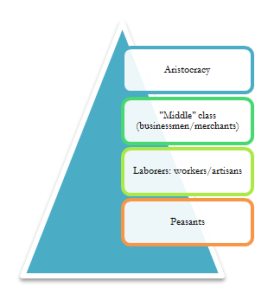
Aristocracy
Since the Middle Ages, these are the affluent nobles and their families who were members of the upper gentry. They were huge landowners with wealthy patrician families and entitlement issues. Ever since the French Revolution, though, their power greatly decreased. They were hated by most, but still were able to control the majority of wealth in the majority of countries. They took place in bureaucratic roles and in the military.
- In the south and east of Europe, the aristocracy held on to wealth and local power (like in the Kingdom of Naples and in Russia—even though they were ≈ 1% of the population, they ruled over peasants. In Russia especially, the aristocracy were tyrants and “pillars of tsarist rule” (quote from the oh-so-amazing textbook)
- Poland/Hungary/Spain: some nobility were really poor and were okay with radical change, but the Magyars in Hungary decided to strengthen themselves through representative government.
- In England, though, the aristocracy had lessened power
- Prussia had the Junkers—owners of estates. A lot of people thought they were ignorant, but they had a tradition of service to the state and loyalty
- France had a reduced aristocracy, of course, but some still managed to maintain a voice in local affairs and guided the arts
Peasants
- Agriculture became more commercial and its production was intended form market rather than sustenance and local consumption
- Not passive at all, maintained old loyalty but resented taxes, needed land, and were crucial players in the Revolutions of France, Spain, Germany, etc.
- Divided by those who owned land and those who didn’t that it sometimes hindered the true potential of their voice in community
Workers and Artisans
- Attracted more attention than the peasantry, but most factory workers earned too little to even sustain a full family
- Lived in slums and had restrictions such as the livret (passport) that French workers were required to show
- Labor movements such as strikes, boycotts etc. that didn’t always work—the Workingman’s Association for Benefiting Politically, Socially, and Morally the Useful Classes (WABPSMUC? I’d work on the name a little) failed
Population Dynamics
The times were changing—cities were growing, more people consumed more food, and markets were expanding. Young people made up a higher proportion of the population than old, and there was a distinction in birthrates by class (differential fertility)
Thomas R. Malthus’ An Essay on the Principle of Population as It Affects the Future Improvement of Society
The Age of Metternich
When France sneezes, Europe catches cold.
And then all hell breaks loose.
The period from 1815 to 1848 is known as the Age of Metternich, after the diplomat of the same name who dominated European politics. It deals with the differences in the balance of power—Britain vs. France/Russia, Austria vs. Prussia, etc. It starts off with the remnants of the Concert of Europe—The Quadruple or Holy Alliance is present, and Metternich has three big problems: nationalism (Slavs and Hungarians are revolting in Austria), the possibility of German unification (will Prussia gain power?) and liberalism (how do we crush the thing?) It started off in Britain…
Metternich’s First Grudge: Great Britain
Their withdrawal from the Quadruple Alliance in 1820 had gotten Metternich a little suspicious, but they soon became the world’s leading example of liberalism. Not good, not good at all.
- Economic crisis from demobilization and collapse of wartime markets à agitation for reform, there had been no major governmental reform since the Glorious Revolution
- Government responded with repression (habeus corpus suspended for the first time in English history in 1817)
- Peterloo Massacre– meeting in Manchester (1819) scared local magistrates enough to call out troops, several people killed
- Parliamentary response was the Six Acts of 1819 which restricted public meetings, prosecuted radicals, and imposed a stamp tax to crush radical press à scandals with personal life of George IV breed discontent
- Repealed Combination Acts that had banned unions
- Sir Robert Peel stopped prosecution of newspapers and use of political spies
- Reform Bill of 1832, passed by the liberal party, increased suffrage to 800,000 well-to-do men (based on property or rent)
- Elimination of local variation for a national standard
- Solved the borough crisis (there was a population shift, creating so-called “rotten-boroughs”—old, empty towns. Birmingham and Manchester had no Parliamentary representative despite being booming cities. There were pocket-boroughs all over the place and there needed to be redistribution of representation, which is what the Reform did)
- Slavery abolished in 1833, Factory Act and Poor Law passed in 1834 limited work hours and respected the rights of poorer citizens
- Chartism was an amorphous workers’ movement that tried to establish the “People’s Charter”. Charitists held huge demonstrates, caused riots, and wanted political democracy
- Corn Laws were grain tariffs that benefited the land-owning class. Richard Cobden and John Bright, fairly large manufacturers, became effective spokesmen against this
AND THEN…IN THE YEAR OF 1830… A THREAT TO THE METTERNICH SYSTEM!
The Revolutions of 1830
Of course, it starts in France.
- Belgian monarchy established in 1830 (acquiesced lands from Dutch that Britain and France had squeezed out)à triumph of liberal constitutionalism
Charles X (none another than the amazing Count of Artois!) is an ultraroyalist. He’s also a crazed wacko.
- Rids of the National Assembly in the July Ordinances (takes away half of the vote, there’s no freedom of speech)
- This is the setting of Les Mis—hit the barricades! So then, of course, Charles flees the country, much like his predecessors
The government is about to transition to a liberal monarchy, but the Marquis de Lafayette steps in (and he’s old by now…) and proposes that a new guy steps in.
Louis Philippe de Orléans
- Known as the “citizen king”
- Talleyrand becomes the foreign minister (doesn’t he get around…)
- Tricolor flag replacing the Bourbon one à establishment of the July Monarchy
- Guarantees of political freedom, doubling suffrage, professionals replacing aristocracy (Louis is okay with a limited monarchy)
- in 1832, Duchess of Berry tried to stage a revolt against him—Louis posed as a member of the bourgeoisie but he wasn’t supported by all
- Center of stability à brought Napoleon’s body back from St. Helena and placed it in the crypt of the Invalides (when I saw the tomb, it was really, really ornate—marble tomb with flowers and neat engraving. Also pretty spooky.)
In Spain, King Ferdinand VII died in 1833, leaving the throne to his young daughter Isabella to succeed him. His brother, Don Carlos, denounced this proposal and began an uprising that lasted for six years. The Carlists wanted an autocracy and traditional claims of Catholicism set forth. He was eventually defeated but he won a place as a chivalric hero.
By 1848, Metternich is fed up with being the policeman of liberalism and nationalism. He doesn’t want to crush revolts anymore. He’s an old man and wants out of politics. But of course, when Metternich leaves, Europe is lost…
Revolutions of 1848
1848 is a watershed date—it is known, sometimes, as “the turning point in history where history refused to turn.”
- End of Age of Metternich
- German nationalists want to unify Germany, but there’s a problem: the Austria vs. Prussia rivalry
- Whom does the crown go to?
- 39 different states, 38 will have to lose power à threat to a balance?
- Is this even a viable option?
Frankfurt Assembly (May 18)
- Nationalists from different states write a liberal constitution for a potential unified Germany (they modeled themselves after the National Assembly)
- Big Germans vs. Little Germany… one big Germany with Austria, or a smaller Germany with Prussia, without Austria? People in Austria are Hungarian…(Friedrich Wilhelm IV backs the Little Germans, who win)
- Fred doesn’t take the crown—”I refuse to take this crown from the gutter”
- Scared about going to war with Austria
- Rather be the absolute ruler in Prussia than the limited ruler of this new country
- Doesn’t want to upset Nicholas I in Russia
- Fred doesn’t take the crown—”I refuse to take this crown from the gutter”
…AND SO REVOLUTIONS ENSUE.
The Opening Phase
France
- France was under the government of François Guizot and Albert Thiers; they refused to widen suffrage à fall of the monarchy
- Banned banquet scheduled for Paris, members of the Chamber of Deputies said that they could come anyway—barricades for workers who couldn’t afford to go. Louis Philippe abdicates à A NEW, SECOND REPUBLIC! (February 22)
- Barricades become the voice of the people
- April 23—French elections
- Alphonse de Lamartine, a Romantic poet
- Louis Blanc (socialist)
Germany/Hapsburgs:
- March 3—Hungarian demands for independence
- March 12— students rise in Vienna
- March 13—Metternich resigns
- March 15-31—Hungarian autonomy à Diet cheered Lajos Kossuth, leader of Magyars
- April 8—Czech’s are given a chance to come to assembly
- April 25—Constitution for Austria
- May 15—Demand democracy
- May 22—Emperor flees
Germany/Prussia:
- March 15—Berlin rising
- March 18-21—Prussia calls Landtag
- May 18—Prussian national assembly meets
- May 22—Prussian constituent assembly meets
Italy
- January 12—Palermo revolts
- February 10/17—Constitutions written in Tuscany and Piedmont
- March 14—The Pope gives a constitution for the papal states
- March 18-22—Milland revolt known as the Five Glorious Days
- March 22—Venice declares republic
- May 30—Italian troops defeat Austrians
The Fatal Dissensions
Revolutionaries began to fight… liberalism vs. radicalism… Who gets the vote? Workers vs. Bourgeoisie.
France
- June 23-26—The June Days insurrection (national workshops)
- November 4—Constitution
Germany
- June 12—Prague bombarded; Pan-Slav congress dissolved
- June 22—Peasants are emancipated
- September 17—Hapsburg army from Croatia invades Hungary
- June-September—Frankfurt assembly supports Prussia against Danes in Schleswig
- October 31—Vienna bombarded and occupied
Italy
- July 24—Austrians defeat Italy
- The Pope flees into Naples after the prime minister is assassinated
The Final Phase
France
- On December 20, 1848, France needs to elect a President. They elect someone who hasn’t lived in France for over thirty-three years… the one, the only, Louis Napoleon Bonaparte! (who overthrows the Republic, calls himself the President for Life, then Emperor Napoleon III)
- Restored universal male suffrage with plebiscites (democratic mandate with authoritarian power)
- Used tax incentives to spur investment
- Wife Eugenie who also loved the arts and build prestige
- Gradual liberalization
Austria
- Found a new leader in Prince Felix von Schwarzenberg, who persuaded the emperor to abdicate in favor of his eighteen year old nephew Franz Joseph I (December 2)
- January 5—Budapest occupied
- April 13—Hungary declares a republic
- June 17—Russia invades Hungary
- August 13—Hungary relents
Prussia
- King dissolved Landtag and made his own constitution
- Rejects Frankfurt proposals
Italy
- Complete failure
- February 9—Roman Republic established
- March 23—Defeat of Piedmont by Austria
- June 30—Rome falls to French
The End.
When Metternich leaves, it helps the resistance to Revolution à Camille de Cavour, Otto von Bismarck; nationalism is the name of the game
The ABC Paradox
If minority B demands independence from A, citing that it is of a different nationality, then the minority of B (which is C) will revolt against B. In fact, C and A might ally against B.
A = Austria
B = HungariansC=Croatians/Slavs/Czechs

Unification of Italy
BACKGROUND:
1848—Karl Marx writes the Communist Manifesto, and claims, “there is a specter watching over Europe, and it is communism.”
- Previously liberal revolutions are becoming radical
- Bourgeoisie vs. working class à Marxist revolutions coming up
1860—Nationalism sweeping throughout the globe
- Japan in 1860s: Meiji restoration
- American civil war: 1861-1865
So far, why hasn’t Italy unified?
- Lost economic power (think back to Machiavelli predicting the fall of Italy after the Renaissance) à trade shift from Mediterranean to Atlantic
- Austria rules over parts of it
- How do you kick out Austria?
- How do you kick out the Pope?
- Controls papal states
- Development of city-states, no clear togetherness
Flavors of Nationalism
- 1. Liberal—this is present in the French revolution
- a. No country is better than another
- b. Each nation is unique and filled with its own character and quality
- c. All nations should be led by people of their own nationalist who understand the nation—they can give a constitution that is rational, fair, and just
- 2. Militaristic—associated with Social Darwinism and realpolitik
- a. Claim that one nations is better than all others
- b. Exploited by Machiavellian politicians who want power
i. Realpolitik—literally, politics of reality (Machiavelli + foreign policy). Who cares about morality? We want POWER!
Giuseppe Mazzini—The spirit
As one of Europe’s most influential revolutionaries, Mazzini had been living in exile (in London, as a lonely propagandist. His Young Italy movement was a nationalist campaign and a tragic failure until Italy’s time had finally come. He was a strong moralist who criticized the French revolution for valuing rights over moral thoughts.
® Romantic poet and a man of letters—On the Duties of Man
- Written in 1844 for Italian workers in England
- Contrasts with Declaration of the Rights of Man and the Citizen from French revolution (thought it selfish and materialistic)
- Foremost duty of human is to humanity, bad governments fail to realize that
- Devine design—things return to their intended place, countries are remade by people
- Vote of the free man
® Wrote about grievances of peasants, artists, intellectuals, etc.—influence strong in north Italy
® Leader of the Roman Republic during the revolutions
® Keeps nationalism alive in Italy for almost three decades
Then… impending battle: The Crimean War (1853-1856)
– Restless search for prestige: France and Britain vs. Russia over competing claims by Roman Catholic and Greek Orthodox monks to be the guardians of Jerusalem’s holy places
- France pressed the Ottoman sultan to give them privileges, but Russia as the defender of the Orthodox faith demanded a protectorate over Ottoman Orthodox churches
- Russia occupied Wallachia and Moldavia (areas that make up modern-day Romania), lands under Ottoman suzerainty (tributary vassal states leading a limited autonomy)
- Threat to balance of power: England and France
- Only religious? Definitely not. Russia wants the Bosporus strait and a warm water port in the Dardanelles (not going to freeze over in the winter… Peter I had gotten a port but it was useless for ¼ of the year)
– Britain and France send fleets to the Aegean; in October 1853 the sultan declared war on Russia
– Russia sued for peace and agreed to accept terms if they were defined at a European congress
– Between 5,000 and 6,000 deaths
- War fought in Crimea, where it’s hard to access
- Completely weakens Russia—can’t be the bodyguards stamping out revolutions anymore because they took a beating
– Britain, France, and Austria gang up on Russia to save Turkey with the help of tiny Sardinia-Piedmont
- Prime minister of Piedmont, Count Camillo di Cavour, gets involved, hoping that Piedmont will be the country to unify Italy. He wants power and prestige—at the end of the war when they talk about reorganizing land, he can claim some for his country.
- He befriends Napoleon III because he is of Italian descent and they have something in common—they both love Mazzini and they both hate Austria
- Napoleon has incentive to gain land from Piedmont (which proves that Cavour wasn’t really a full nationalist… he was willing to give away Nice and Savoy for the sake of his twisted concept of “unity”)
- Cavour wants to undo Congress of Vienna, allowing for the true spread of Italian nationalism
- King of Piedmont at the time was Victor Emmanuel II, who was not liberal but ruled with a parliament—notorious for a strong military and bureaucracy
- Wanted to make Piedmont the center of Italy’s rebirth: risorgimento—the resurgence.
- Argued that Italy repressed would remain a danger to European order
Ends with the Treaty of Paris (1856). Effects include:
– Conservative (Austria/Prussia/Russia) alliance broken up
– Russia gives up any claims to its so-called protectorate and accepts a ban on warships in the Black sea
– Cavour and Napoleon decide that they want to meet at Plombières… the cauldron of unification is starting to boil
Plombières Agreement (July 1858)
A perfect example of realpolitik (it highlighted deception, aggressive warlike behavior, the power of an image with Britain, and compromise) Cavour wanted to provoke Austria. He told Napoleon III that he would limit Piedmont’s expansion if France would support him. Lombards and Venetians were escaping conscription in Austria by streaming to Piedmont as volunteers, and Napoleon was seeing the truth of the situation—war was inevitable.
On April 29, 1859, Austria invaded Piedmont. There you have it! The Austro-Sardinian War.
® May 1859—things are going well for Piedmont
® July 1859—Papal states are getting excited and want unification—they start overthrowing their governments to join the movement
® Progress is being made and Italy is coming together; uprisings in Parma, Modena, and Tuscany helped. Moderate liberals had taken over!
® Wins the battles of Mangenta and Solferino against Austria, but then Napoleon pulls out (probably because the idiot was looking for some sort of weak buffer zone, and he was also a faithful Catholic who was partially responsible for a fracture of the papal states)
- Treaty of Villafranca between Austria and France to stop the war in order to save Venetia from annexation
By 1862, Italy is (informally) unified, but did Cavour or Napoleon really want this? Cavour didn’t want to fight the Pope, and definitely didn’t want a republic. The revolution was becoming too radical for him. Italy united because of Austria’s incompetence, and the credit doesn’t even go fully to Cavour.
Meanwhile, a bunch of sputtering revolts in Sicily gave more democratic nationalists a change to lead their own resurgence. Former Mazzinians gathered in Genoa and planned an expedition that Cavour did not support or oppose. Their leader?
Giuseppe Garibaldi—the sword (and Italy’s most popular hero!)
- Exiled in the 1830s to South America, but returns to Italy after hearing about the war
- Directed defense of the Roman Republic in 1849; believes in good causes
- Sails to Sicily with 1,000 volunteers known as the Red Shirts, and just wins battle after battle à known as the Expedition of the Thousand
- Within two weeks, Red Shirt troops occupied Palermo and within a few months, all of Sicily
- Cavour’s getting worried that France is going to invade to stop him, so he sends an army from the north
- Garibaldi the nice guy says that he didn’t fight for himself, it was for Italy. He gives everything to Victor Emmanuel, and becomes a corn farmer. The guy, I suppose, lives happily ever after.
The Kingdom of Italy now includes everything but Rome and Venetia (Italy acquired Venetia in 1866; Rome was annexed when French troops withdrew during the Franco-Prussian war of 1870. Pope Pius IX forbade Catholics to take part in national elections—Italy was united, sure, but it was poor and agricultural. It had a long way to go.)
The Unification of Germany
Why didn’t Germany unify?
- External forced such as France and Russia
- Power clash between Austria and Russia
- Leaders of small principalities would never want to give up power (wars of religion…)
- Romantic ideas: the unique individual need not heed to a larger state
In the end, though, Prussia took control.
- Tariff union known as the Zollverein did not include Austria
- Lots of military power, but with Wilhelm I (1861) mounts throne, he can’t raise taxes without Parliamentary consent
- Chief minister Otto von Bismarck named
Otto von Bismarck, in 1862, is appointed the prime minister. He’s the last resort of a fallen king who wants to rid himself of controversy. He forces people to pay taxes and starts beefing up the army. Also a Prussian nationalist.
® Great Man Theory—certain great individuals can see things that other people can’t; they manipulate events according to a structured plan.
® People often confuse Bismarck as having two personalities—at first, an aggressive one that loved war and then a nicer, more diplomatic one, but really he was just an arrogant guy who had Prussian interests in mind.
® Infamous blood-and-iron speech… “the great questions of the day will not be settled by speeches and majority decisions—that was the mistake of 1848 and 1849—but by blood and iron.”
| Danish War (1864)Schleswig-Holstein | Germans did not like the fact that Denmark possessed Schleswig and Holstein (The Danish king had annexed it), so Prussia asked Austria to help them win the provinces back.Now, this was supposedly to help pick a fight with them later, but really Bismarck needed to act in the interests of German rather than Prussian nationalists, so he needed support.- Defeats Denmark in five weeks and gets the provinces back – Austria asks for Silesia (as if they get it…) |
| Austro-Prussian War/Seven Weeks (1866) | Friction with the Hapsburgs was increasing day by day, and Bismarck was preparing for war. He won Italy’s support by promising it Venetia and told Napoleon III that he could gain territory.- Three troops march into Bohemia (with civil war in Germany!), and Prussia defeats them at the Battle of Sadowa– Takes no land or money from Austria, tells them they are no longer a part of German affairs, and takes Holstein (he needs support from them later on) – Most of Germany is now unified—North German Confederation
– Austria in a dual monarchy between itself and Hungary |
| Franco-Prussian War (1870) | Germany needed more than a stopgap election to truly “unite.” When Queen Isabella II abdicated the throne in 1868 (the Spanish throne, that is), a Hohenzollern prince (Leopold) declined to take over: Crisis of the Spanish Succession. France is getting mad and demands to meet with Wilhelm. They arrange a relaxing, calm meeting at the spa of Ems à Prussia withdraws nomination.France is hurt and asks Prussia never to do this again, but they don’t make any promises.
|
The Second Reich (the Holy Roman Empire was honored as having been the first)
- Insecure middle classà rapid industrialization?
- Bismarck wanted to demonstrate supremacy of the state by moving in on the Catholic Church and socialist party (Kulturkampf)
- Tried to ensure the Germanization of Alsace and Polish parts of Prussia, but did not work
Priests and nuns became martyrs and the Catholic Center party was gaining votes (Pope Leo XIII became Pope in 1878)