AP European History Guide
A comprehensive study tool for acing European history and getting a 5 on your exam
Threat of Knowledge & WWI
The Threat of Knowledge
Topics:
- Nature, Society, and the Money that Runs it
- La Belle Époque
- Fin de Siècle
- Domestic Policy
World War I
Topics:
- Inevitability or a Choice? The Coming of WWI
- In the Trenches
- A Temporary Peace
Nature, Society, and Money
The second half of the nineteenth century is characterized by unprecedented economic growth that filled most of the continent. Department stores use new techniques of merchandising to exponentially increase mass consumption.
- Thomas Edison‘s incandescent light bulb (1870) invented (hallelujah)
- Steam turbine more efficient than steam engine
- Chemical processes and synthetic techniques
- Bessemer steel process
The German economy was the star of this modernization—already rich with natural resources (hey, let’s steal Alsace and Lorraine and then squeeze all its value out! Yay!) Enhanced railroad communication, produced engineers through a stellar education program, and started producing goods in huge factory—growth of cartels. Not to be confused with the marijuana being trafficked in Mexico. But same concept. Keep an eye on these guys—they look pretty shady come WWI.
- Agricultural wealth responded with tariffs
- Prices continue to go down
- Trade barriers
- Period of demographic transition and general urbanization
Of course, new products also require new techniques to manufacture them:
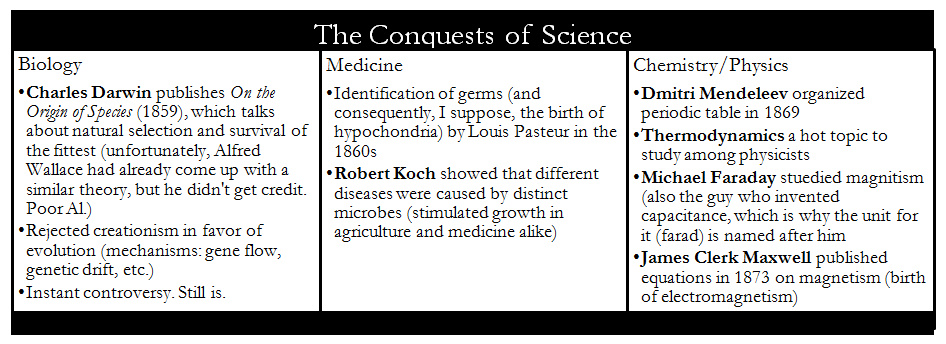
Pondering the depths of the universe and the general concept of philosophy…
| Auguste Comte | Especially impressed by social role of religion and how it compares to natural science. Secretary to Saint-Simon; confident in socialists- Thought society would soon be organized by “rational” principles (I say this with caution…) like positivism (published ten volumes based off the one word. This is also known as rambling)- Key to civilization was in humanity’s understanding of the world in three stages
– Religion of humanity |
| Georg Wilhelm Friedrich Hegel | Comprehensive philosophy comparative to that of Aquinas or Aristotle—determined to reconcile science and faith, Christianity and the state, and fundamentally, the eternal from the temporal. (I thank the textbook for such wonderful prose; a nice summary of Hegel’s works)- Thesis (society’s implicit statement about life) breeds a antithesis (the counterargument, or what I call the “haters”… creates a clash of opposites, and a synthesis– Together, they create the dialectic – The dialectic is constantly moving with the World Spirit– Hegelian philosophy influenced Marxism |
| Karl Marx/Marxism | The one, the only… the bourgeois scholar KARL MARX!- Published The Communist Manifesto with his friend and fellow philosopher Friedrich Engels. It was nothing more than a pamphlet, though, and provided support to the working class during the revolutions of 1848. Congrats, Marx, you predicted what is happening in the present.- Publication of his magnum opus, Das Kapital—he was a “scientific” rather than a “utopian” socialist—but let’s be real; they’re all chasing a dream.Marx is really a culmination of French socialism, British economics, and German philosophy.- Theory of History: dialectic materialism, which rejected Hegel’s idealism—its not conflicting ideas, it’s conflicting classes. (But is there really a division of ideas based on class structure? I think not—ethical issues being one of them. Class structure is really a measure of social standing and economic prosperity at its core.) – Feudal society à French revolution à capitalism; we are now faced with a new revolution and dialectic: the capitalist bourgeoisie vs. the Proletariat
– Through a Dictatorship of the Proletariat, the working class can take over. YAY FOR NORTH KOREA! ALL HAIL OUR ESTEEMED AND ALL-POWERFUL LEADER! THAT PICTURE OF US SMILING UNDER THE GOVERNMENT ISN’T PHOTOSHOPPED, I PROMISE! Class struggles then will cease to exist—the state withers away. – Society should sit down and scientifically decide what to produce and in what quantity—the bourgeoisie “forged the weapons that bring death to itself”, let’s all live a comfortable life with the wealth they accumulated
– We need to build class consciousness, which is just an instrument of oppression. To hell with the system! Let’s build a new world! All the bourgeois have been feeding the proletariat with opiates—religion, racism, nationalism, and opportunism. It’s dividing you. Unite! By 1881, Marxism had its set of revisionists—people who were editing the original doctrine. Even Marx himself understood the world had changed since The Communist Manifesto, and not necessarily as he had predicted. – Revisionist socialists or evolutionary socialists realized that the road to communism was a long, windy path, but workers could get imminent social change – Socialist parties—socialism platform using a democratic system By 1885, democratic thinking had settled in. France, Germany, and Britain granted universal male suffrage and advocated better working conditions (minimum wage, right to strike, 40-hour work week.) Proletariat were (temporarily) appeased. |
| Social Darwinism | A bunch of entitled guys who decided to claim scientific objectivity using Darwin’s work—congrats, you just managed to take the work of a brilliant naturalist and twist it meaningless.- Survival of the fittest applying on a psychological basis—i.e. those who succeed will do well. You’re a failure? Sucks to suck.- Basically a seed of racism, militarism, and general arrogance. |
| Herbert Spencer | Wrote Synthetic Philosophy (series of studies published between 1850 and 1896), which were similar to that of Comte and Darwin.- Progress is a necessity- Argued that the marketplace is the true test of fitness- Believed in “rationalism” |
| Anarchism | Anarchists wanted to return to the state of nature, and wanted to annihilate government as it was. They decided the best way of doing so was by assassinating members of government, thereby causing the system to collapse. Congrats. You were the immediate cause of World War I. How can you sleep at night?- Resorted to terrorism (had a sweet spot for bombs)- Illegal and unorganized- Key anarchists: Mikail Bakunin, Prince Peter Kropotkin (exiled aristocrat) and Pierre Joseph ProudhonBakunin was a rival of Marx for the hearts of the workers—he decided the Dictatorship of the Proletariat was oppressive. Too bad Marx countered with the classic “you’re a terrorist.” – Member of Hell (a group of anarchists? Or a punk rock band?) – People in Hell knew only knew who recruited you and the two other people you were mandated to recruit (so you were a part of two terror cells… if caught, the entire organization is never compromised) – Members supposed to carry acid (to throw on your face, making you impossible to recognize), cyanide, and a revolver Assassinated the president of France in 1894, prime minister of Spain in 1897, empress of Austria in 1898, king of Italy in 1900, and president o the United States in 1901. |
| Syndicalism | Believed in the concept of a general strike—let’s stop working and slowly we’ll bring the state to its knees! Let’s form unions/syndicates. Also known as anarcho-syndicalism.- Wanted to bring down bourgeois society- Georges Sorel and Henri Bergson—Sorel published Reflections on Violence (1908)- Knowledge based on reason rather than prejudice |
What makes this most interesting, though, in all these ideas—they treat government as a separate entity than the people. We do so even now, claiming things like the government will subsidize agriculture. The government is just an institution created by the people. The abstract sense of it is hyped up a lot more than it should be (or was ever intended).
La Belle Époque
-the beautiful era-
The thirty years or so before WWI are really represented by the beautiful Parisian cityscape in the 1890s—a city of lights, a brand-new Eiffel Tower in the center, crowded cafés, etc.
Entertainment and sports become professions—folk songs about everyday activities (paid singers)
Music halls and outdoor gardens
Adoption of the English week (Sundays and half of Saturday off)
More freedom for women
New sports (Marquis de Queensbury rules for boxing) → official regulations (teams, leagues, match rules) → Olympic games in 1896 (created through Baron Pierre de Coubertin of France)
Growth of mass media (high literacy rates)
New art:
Naturalists believe that artists should present life in object detail, similar to a novel (Émile Zola)… very effective on the stage
Impressionists recreate effects of lighting and color (Edgar Degas, August Renoir, Claude Monet, Paul Cézanne)
Fin de Siècle
-the end of the century-
The end of the century marks the end of a movement, and is characterized by a strong attack on liberalism.
Gender Wars
Three types:
Middle-class with charitable work and education (i.e. International Congress on the Rights of Women in 1878 during the Paris exposition)
Radical group wanting equal rights rather than protection
Women’s trade union movement (immediate problem of pay and working conditions) → Women’s colleges established at Oxford and Cambridge in the 1870s
The Christian Critique
1864: Pope Pius IX issues Quanta Cura, an encyclical which states the pope had the option of opposing modern civilization
Vatican Council of 1869-1870
Bismarck launched attacks on the Church
Activity in social work (Protestant Salvation Army in 1865)
More respectable among intellectuals
New Thoughts: Nietzsche vs. Freud
| Freud (1856-1939) | Nietzsche | |
|---|---|---|
| Prelude | Both thought that nature was irrational, and both hated the Enlightenment. It was almost as if they represented Hegel’s dialectic, and they were the antithesis to the Enlightenment. | |
| What is the nature of humanity? | Humans are irrational creatures—we are not in total control. There is the world of the unconscious, and the theory of certainty. Some memories are traumatic enough that we have to repress them into the unconscious, but seepages occur in the form of dreams and phobias (or Freudian slips). Neuroses are the result of these repressions, and neurotic people are maladjusted. They can function but have major problems. Psychosis is the state where you can’t cope and you are psychotic. Some people are just discontent—we can never be truly happy because we are always repressing ourselves. Author of Civilization and its Discontents (1930) | Life is a brutal struggle, but what doesn’t kill you makes you stronger. There are really two kinds of people: the masses of mediocrity (who cares about them; their desires are insignificant) and the prominent artisans, the people who have risen above society: the übermensche. There is no such thing as equality—men are inherently unequal. He hates democracy, socialism, communism, and Christianity. Unfortunately, women are little more than slaves. “They are cats, or birds, or at best cows.” “When thou goest to women, forget not thy whip.” He is a cultural elitist with a herd mentality. Author of Thus Spoke Zarathustra (1883) |
| Are there such things as the rights of existence? Do people have rights? | Spent entire career helping maladjusted people (after fleeing Austria in the 1930s as a Jew). He invented psychoanalysis. He started experimenting with cocaine and hypnosis, but then: Interpretation of dreams to understand their meaning (1900). Free association: psychiatrist gives a person a bunch of words to see a reaction. | It depends who. Common people shouldn’t. Don’t let those idiots let the übermensche come down. Artists’ tyrannies should try to fight liberalism, and people should not have rights. |
| What does the individual owe society? | Part of the conscious is known as Id. It has two aspects—the love instinct (eros) and the death instinct (thanatos)—if we satisfy both, life would be a giant orgy, so society needs to curve our Id. This is the superego, or colloquially, the “conscience”. We can still channel eros, which is how beautiful things are created (or, for that matter, thanatos. This may involve a shooting spree.) This channeling is known as sublimation. | Author of Beyond Good and Evil (1880). Society should do anything to help the supermen, and evolution works towards mediocrity. The masses should be enslaved. Look at Napoleon. Are you a member of the herd?? YOU ARE WORTHLESS! Take chances and be different. |
| Is there such a thing as morality? | Society creates morality, which our superego is in touch with—criminals have a deformed superego. Religion doesn’t exist though—its patently infantile and similar to looking for a father in the sky. We can’t have true happiness, so we need morality. | CONFORMITY IS BAD. Morality is created by society and is a tool to bring the supermen down. All religion is dumb, but Christianity is the worst. Live your life as if you would want to live it again: infinite recurrence. |
| Are you a revolutionary? | No (but in reality he is). He tried to split the mind, but he has tremendous influence in surrealist art. Einstein split the atom, Freud split the mind. | He’s a social critic—people are unequal…. and yes, I’m an übermensche. PS I’m not an anti-semite even though Hitler loves me. |
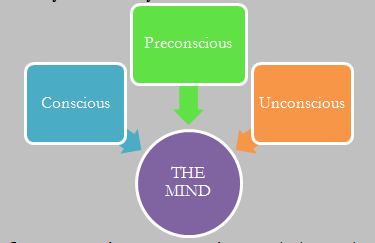
The Freudian Dynamic of the Mind
Domestic Policy
France
After Louis Napoleon surrenders in the Franco-Prussian War, people were happy about the proclamation of a republic, and its new leaders sought to mobilize.
-
May 1870—by September the outcome was set. September 1, 1870: Battle of Sedan, in which the French are crushed.
-
Napoleon III is captured and is sitting in a Prussian jail, but Bismarck isn’t done. He marches into Paris (the Siege of Paris) from September 1870 to January 1871, making it clear that no food, fuel, or people were going in or coming out of Paris.
-
5,000 personal pets eaten (Alex de Horne)
-
Rat hunts for food
-
Kill all the zoo animals (except for the lions and the monkeys)
-
Chop down all the trees in the city
-
Hot air balloons from the exposition fly, but this escape failed
-
-
January 1871: they surrender, and face a reparation of five billion francs, as Germany takes the region of Alsace-Lorraine, which is rich in coal/iron.
-
Victory parade through Champs-Élysées, and in the Hall of Mirrors, the Second Reich is proclaimed.
-
First cause of WWI? Check.
Adolphe Thiers is named chief of the “executive power” (postponing the debate of republic vs. monarchy).
-
Decides to disarm the National Guard
-
Municipal council of Paris declares the city a self-governing commune: Paris Commune led by Charles de la Cruz
-
CIVIL WAR (for like the fifth time); conservative assembly vs. communes → two months of bloodshed before troops break into the city (May 1870 known as the bloody week)
Anarchist Louise Michel—”I belong to the social revolution.”
-
Stable republic gradually finances loans needed to pay Germany (soon oversubscribed), and moderate republicans take over. Monarchists then got a little worried, so they oust Thiers and replace him with a monarchist. Restoration attempt fails → establishment of the Third Republic
-
Monarchists don’t know whom to pick between grandson of Charles X vs. grandson of Louis Philippe (plan fails due to internal struggle)
-
Chamber of Deputies established; elected by direct, universal male suffrage, and an indirectly elected Senate
-
Recognition of unions, elementary education mandatory, but no big social welfare or public work projects
-
Captain Alfred Dreyfus, a Jewish member of the General Staff, was accused and convicted of providing a military attaché with French documents (Dreyfus affair)
-
Series of sensational trials and huge public demonstrations
-
Confusing ruling; man had forged evidence against Dreyfus
-
General Georges Boulanger more popular than politicians → prime minister became Clemenceau
-
Germany
-
Conservatives learn that you can look good in the public eye by forming political leagues teeming with propaganda (financed by Prussian Junkers and industrialists → sensational rile-the-crowd stuff). Will II was known as the Labor Emperor
-
Social Democrats become largest party in the Reichstag in 1912, dominating labor unions as well (Eduard Bernstein published Evolutionary Socialism in 1897)
-
In 1890, Wilhelm II comes to power, seeking Germany’s “day in the sun.” He reads Alfred T. Mahan’s Influence of Sea Power and wants colonies (and a navy to supplement it). He threatens Britain and fires Bismarck. Germany starts out producing everybody in steel.
Italy
-
Former radical turned hero Francesco Crispi becomes prime minister. Policies include anticlericalism, trade wars with France, and disaster in Ethiopia.
-
Riots in Milan (tons of bloodshed, suppression of media, bans on many organizations)
-
-
New prime minister Giovanni Giolitti (1903-1914) acknowledges the right to strike, begins nationalizing railroads and life insurance, supports universal male suffrage (1911), etc.
-
Imperial ambitions fail but better than the predecessor
Russia
-
In 1855, Alexander II takes over. He is 6’5″ and dresses like Lincoln.
-
By 1861 he emancipates serfs and slaves, gives them half the land of Russia, with mortgage payments, living in mirs or communes
-
By 1856, ends the Crimean War
-
Reforms from above to avoid revolution
-
Third section/secret police abolished
-
Allows democracy at local level (Zemstvos)
-
1866: plans for a constitution and national parliament, but anarchists revolt
-
-
Assassination attempts: sniper misses, but over a dozen attempts occur
-
1881: bomb under carriage; loses an eye. Successors Alex III and Nicholas II hate anarchists
-
Moral: nice guys finish last
-
Alexander II becomes czar in 1881; uses Orthodox Church and secret police (Okhrana)
-
Local governors authorized to use martial law and persecute Jews
-
-
Continued by Czar Nicholas II (took over in 1894)
-
Japan attacks Russians at Port Arthur → Russo-Japanese War; disaster for Russia
-
January 1905: striking workers in St. Petersburg march to Winter Palace → Bloody Sunday
-
Assembly of notables called, consultation of Imperial Duma
-
Economic life halts—most effective general European strike thus far
-
-
October Manifesto guarantees a constitution
-
Fundamental laws (May 1906): Czar retains veto, appoints ministers, commands executive branch; upper house in addition to Duma
-
Elections gave Cadets a parliamentary majority
-
Prime minister 1906-1911: Peter Stolypin, education reformer, turns away from mir system
-
Austria-Hungary
-
Count Eduard von Taaffe elected prime minister (1879-1893)
-
Supported by crown more than Parliament
-
Universal male suffrage in 1907 → rise of Christian Socialists and Social Democrats
-
-
Social programs and anti-Semitism
-
Magyars maintain power in Hungary via language requirements in government and schools
-
1903: Hungary asks for more autonomy → Emperor Franz Joseph I suspends constitution
-
Spain
-
Liberal coalition holds power 1854-1863 → 1866 flight of Queen Isabella II
-
Military installs her son Alfonso XII
-
Spanish-American War: Spain withdraws from Cuba; cedes Puerto Rico, Guam, Philippines to U.S.
-
Rising tensions; week of violence in Barcelona
Britain
-
Legal equality increases: opening civil service to competitive exams, removing “legal disabilities” of Jews, eliminating taxes for Church of England
-
William Gladstone (Whigs → Liberals): wants increased suffrage, defeated in Parliament
-
Benjamin Disraeli (Tories → Conservative): increases vote to all men paying property taxes
-
Army reformation, disestablishment of Anglican Church of Ireland, public health act, strikes allowed
-
Universal male suffrage 1885
-
David Lloyd George proposes a people’s budget placing social welfare costs on the rich
The Coming of WWI
-
Franco-Prussian War ends January 1871. Wilhelm I king, Bismarck chancellor
Foreign Policy
-
England: protect India, Africa, Australia, democracy, navy, Suez Canal
-
France: “lost provinces” Alsace-Lorraine, revenge against Germany
-
Russia: warm water port, Pan-Slavism, autocratic
-
Austria-Hungary: nationalize Slavs
-
Germany: Triple Alliance (Germany, Austria-Hungary, Italy), maintain balance with Britain and France
-
Ottoman Empire: collapsing, power vacuum, revolts, controls Balkans
Russo-Turkish War
-
Russia heads for warm water port → Britain, Germany, France react
-
Congress of Berlin 1878: Bulgaria, Serbia, Montenegro created; Austria-Hungary gets Bosnia-Herzegovina; Russia retreats; Germany keeps peace
-
Reinsurance Treaty 1881: Germany-Russia friendship renewed yearly (breaks under Wilhelm II)
-
Franco-Russian Alliance 1894 → France and Russia ally
-
Fashoda Crisis 1898 → Anglo-French Entente Cordiale 1904
-
German Chancellor sends gunboat to Agadir
-
1906 launch of Dreadnought
-
Russo-Japanese War 1904-1905 → Russia defeated
Triple Alliance vs. Triple Entente
-
Triple Alliance: Germany, Austria-Hungary, Italy
-
Triple Entente: France, Britain, Russia
Balkan Crises
-
1908: Bosnian Annexation Crisis → Austria-Hungary annexes Bosnia-Herzegovina; Serbia upset, Russia compromises
-
Formation of Serbia-Russia alliance
-
1911: Second Moroccan Crisis
-
1911: Tripolitan War (Italy/Turkey)
-
1912: First Balkan War (Serbia, Bulgaria, Greece vs. Turkey)
-
1913: Second Balkan War
-
1914: Sarajevo → assassination of Archduke Franz Ferdinand
-
Austria-Hungary blames Serbia → Germany supports Austria (blank check)
-
Schlieffen Plan: Germany invades France through Belgium → WWI begins August 1914
-
Historiography of the Blame
-
1919: War Guilt Clause (Article 231, Treaty of Versailles) → Germany blamed
-
1928: revisionists Sidney Faye (Harvard) and Harry Elmer Barnes (Yale) deny sole German blame
-
Russia first mobilized
-
Serbia provoked Austria
-
Austria-Hungary issued irrational demands
-
France unclear intentions
-
-
Europe “stumbled into war”
Causes generalized:
-
Militarism: Navy and army frenzy (Britain vs. Germany)
-
Alliance system: Mobilization vs. mediation (Russia), Triple Alliance vs. Triple Entente, Austro-Serbian (Pan-Slavism)
-
Imperialism: Cape to Cairo railway, France’s east-to-west railway, foreign influence
-
Nationalism: Pan-Slavism, pride/humiliation, lost provinces
Reevaluating Responsibility and the Interwar Period
By the end of 1928, the consensus shifted: Germany was not solely to blame for World War I, prompting debates about revising the Treaty of Versailles.
-
When Hitler began violating the treaty, enforcement was minimal because international faith in it had waned.
-
In 1961, historian Fritz Fischer’s Germany’s Aims in WWI revealed that German leaders had actively pursued the war.
-
Captured Allied documents in 1945 confirmed that German politicians had manipulated events to provoke conflict, aiming to wage a quick, decisive war for territorial gain, suppress socialist movements, and counter the perceived “Slav peril.”
-
L.C.B. Seaman described 1914 as a failure of intelligence and goodwill: the war was highly probable but not necessarily inevitable, emphasizing the absence of a Bismarck-like peacemaker.
The Trenches and Total War
-
August 1914: Germany invades Belgium, triggering French alarm. Russia mobilizes prematurely, leading to chaos on both fronts.
-
September 1914: Germans retreat at the Battle of Marne; trench warfare begins, stretching from the Alps to the English Channel.
-
1916: Battles of Verdun and the Somme result in over a million casualties, showcasing the futility of Napoleonic tactics in modern warfare.
-
Innovations like poison gas, machine guns, tanks, and airplanes redefine combat.
-
Naval warfare: the Battle of Jutland and unrestricted submarine warfare highlight the global dimension of the conflict.
Impact on Civilians
-
Civilian involvement was direct: food rationing, conscription, and propaganda became widespread.
-
The Armenian Genocide of 1915 exemplifies the war’s totality, with at least 800,000 civilians killed.
-
Women’s roles expanded dramatically in factories, offices, and farms, leading to suffrage in several countries.
Peace Efforts: Wilson and the Fourteen Points
-
Woodrow Wilson envisioned a moral foreign policy and a war that would end all wars.
-
January 1918: Fourteen Points proposed free seas, limited armaments, self-determination, and the League of Nations.
-
November 1918: Germany accepts these points.
Paris Peace Conference (1919) and Treaty of Versailles
-
The “Big Three”: USA (Wilson), France (Clemenceau), Britain (Lloyd George); Italy and Japan had secondary roles.
-
Key Treaty provisions:
-
Saar coalfields under French control for 15 years
-
Demilitarization of Germany
-
Recognition of new states: Austria, Hungary, Poland, Czechoslovakia, Estonia, Latvia, Lithuania, Yugoslavia, Turkey
-
Military restrictions: 100,000 soldiers, 4,000 officers
-
Reparations: $5 billion initially, $33 billion by 1921
-
War Guilt Clause (Article 231)
-
Various colonial mandates
-
-
Germany resisted signing, ultimately forced under threat of renewed conflict.
-
USA, Russia, and Germany were not members of the League of Nations, weakening its effectiveness.
Seeds of German Instability
-
The “stab-in-the-back” myth: Hindenburg and Ludendorff helped transition Germany into a democratic republic (Weimar Republic), blaming socialists for defeat.
-
January 1919: Spartacus League revolt crushed by Freikorps; bitterness lingered between the KPD and SPD.
-
1923: French occupation of the Ruhr sparks hyperinflation in Germany, with the Mark collapsing from 4.2 = $1 in 1914 to 4.2 trillion = $1 by November 1923.
-
Adolf Hitler’s Munich Putsch emerges during this crisis; his imprisonment yields Mein Kampf.
This period laid the political, economic, and social foundations that allowed extremist ideologies to rise, eventually culminating in World War II.
Units
- Preface
- Pre-Renaissance
- The Renaissance & Reformation
- Wars of Religion, New Monarchs, 17th C England
- Scientific Revolution, Art, Locke & Rousseau
- Absolutism, European Balance of Power
- The Enlightenment, New Economics, Cultural Change
- The French Revolution & Reign of Terror
- Napoleonic Era, Congress of Vienna, Concert of Europe
- Age of Metternich, Nineteenth Century
- Threat of Knowledge & WWI
- Interwar Period, and WWII to post-Cold War
Latest Updates
Thanks for using AP Euro Guide.
Keeping a website up and running is not free for us. Many hours of work were put into creating the guide, as well as setting up and funding this website. Consider donating a dollar to keep our guide available and online. Go to our homepage, and click on the “Donate” button.