AP European History Guide
A comprehensive study tool for acing European history and getting a 5 on your exam
Pre-Renaissance
What was the legacy of Rome?
Concept of “empire”
Pax Romana
Greek culture (humanistic, representation of ideal beauty)
Law of Rome – binding an entity
Spread of Christianity (312 C.E. – Christianity’s big break where Constantine puts the Christian cross on his shield, wins a battle, converts… by 330 C.E. it’s the official religion of the empire and older pagan religions are persecuted)
Caesaropapism – “Caesar” and “Pope” are the same entity (merging of Church and state. Example would be Pharaohs of Egypt, or the opposite of Rome)
Europe leaps forward because it has such a separation but by 410 C.E. a barbarian army pillages the city of Rome and by 476 the Roman empire is completely overthrown.
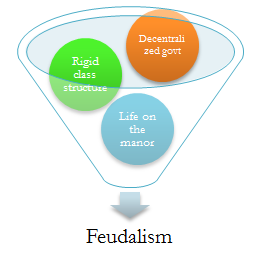
500–1400 C.E. there is a mix of culture and people of “Europe” formed from Germanic, Roman, and Catholic influences, known as the western omelet. Feudalism emerges as people seek protection after the fall of Rome.
Powers of the Church
Social
Controls what people think and how they act
Controls education
Sacraments (keys to salvation… baptism, confirmation, matrimony, the Eucharist, ordination, penance, and extreme unction)
Baptism – washing away original sin of being born. If you are not baptized and you die, instead of going to heaven or hell, you go into limbo (which is not to be confused with purgatory, a temporary hell).
Eucharist – going to mass. The point where priests take a wafer and transform it into the body of Jesus is called the Miracle of the Mass, or transubstantiation.
Must be performed by a priest.
Political
Excommunication and interdiction (kicking people/countries out of the church)
Economic
Tithe, 10% tax everyone has to pay for being a part of the Church
Church owns 15–20% of all land in Europe
Boxing Matches of the Middle Ages
Round 1 — Popes vs Kings
Gregory VII vs Henry IV (HRE Emperor)
Issue: Investiture (appointing of an ecclesiastical power)
In 1025, Henry IV attempts to appoint the Archbishop of Milan, but the Pope says no and appoints someone else. Then, the King arrests the Pope, but the Pope then excommunicates the King. The King goes to Canossa and begs, convincing the Pope to let him back into the Church.
Church: 1, State: 0
Round 2 (1215) — Popes vs Kings
Innocent III (1198–1218) vs King John of England
Issue: Investiture
King appoints Archbishop of Canterbury and the cat-and-mouse game of trying to establish dominance continues until the Pope throws the entire country of England out of the Church (WOAH THERE) and the nobles force the King to sign the Magna Carta (formation of Parliament).
Church: 2, State: 0
1096 — First Crusade
Pope Urban III unleashes the First Crusade:
Cultural diffusion
Decline of feudalism
Power of king/nobility weakened
Trade in towns leading to monetary gain
Creation of bourgeoisie, a new class, a middle class
Do kings like the bourgeoisie?
Yes:
Destruction of feudalism
Lack of noble armies
King can tax them!
Do bourgeoisie like the king?
Yes:
Unifying code of law
Safe town with king’s protection
Leads to the end of strict feudalism. Crusades are a catalyst of this, NOT the cause.
Round 3 (1305) — Popes vs Kings
Boniface VIII vs Philip IV of France
Issue: Taxation of the Church (Philip needs money for 100 yrs war)
The Pope tells everyone that you can’t tax the Church but Philip retaliates and says he doesn’t care what the Pope thinks, he wants money. The Pope excommunicates Philip and Philip then arrests the Pope. Boniface dies shortly after.
When choosing a new pope in 1305, Philip appoints a French pope who moves the papacy to Avignon from Italy and appoints French cardinals. France threads the State into a Church framework, giving Philip more power.
Church: 2, State: 1
Leads to the Avignon Exile or Babylonian Captivity.
The third French pope in a row has an attack of conscience and before he dies moves the papacy back to Rome in 1378. The French cardinals fear Roman citizens will attack them, so they secretly elect a French pope.
The Italians excommunicate the French and vice versa.
Great Schism (1378–1410 to 1414)
A council elects an entirely new pope but neither of the others want to step down.
Council of Constance in 1414 elects one final Italian pope and things settle down.
Damage
Loss of faith
Religious vs political power
Disunity in a fundamentally strong organization
Split of Church
Example:
John Wycliffe (1320–1384) says Pope doesn’t speak for God. One of his disciples, John Huss (1369–1415), gets arrested and burned at the stake as a heretic. All Hussites are killed, and the Pope asks for Wycliffe’s dead body to be burned (an auto de fe). One of Huss’s followers, Zizka, leads a revolt (doesn’t really go anywhere).
Followers of Wycliffe known as the Lollards.
Units
- Preface
- Pre-Renaissance
- The Renaissance & Reformation
- Wars of Religion, New Monarchs, 17th C England
- Scientific Revolution, Art, Locke & Rousseau
- Absolutism, European Balance of Power
- The Enlightenment, New Economics, Cultural Change
- The French Revolution & Reign of Terror
- Napoleonic Era, Congress of Vienna, Concert of Europe
- Age of Metternich, Nineteenth Century
- Threat of Knowledge & WWI
- Interwar Period, and WWII to post-Cold War
Latest Updates
Thanks for using AP Euro Guide.
Keeping a website up and running is not free for us. Many hours of work were put into creating the guide, as well as setting up and funding this website. Consider donating a dollar to keep our guide available and online. Go to our homepage, and click on the “Donate” button.