AP European History Guide
A comprehensive study tool for acing European history and getting a 5 on your exam
Scientific Revolution, Art, Locke & Rousseau
The Scientific Revolution
Date: 1543–1687
Topics:
Science and Technology
Art and Culture
Social Changes and Transition to Absolutism
Intro to Enlightenment
Science and Technology
Why did this come about?
I. Importance of antiquity — going from Aristotelian physics, Ptolemaic astronomy, and Galen’s anatomical models. The revolution revived interest in science and built on old ideas.
II. “Natural philosophers” who reuse humanist ideas to explain the world.
III. Influence of magical belief and need to structure nature — neoplatonism
Alchemy: a forerunner of chemistry; belief that base metals could be transformed into gold or silver, and create potions that cure disease or give eternal life/youth (Paracelsus suggested metals and plants could help cure syphilis)
Astrology: claimed natural phenomena could be predicted with planetary movements
Pythagoras: suggested numerical patterns could explain phenomena
IV. Europe’s fascination with technological invention (from Renaissance)
V. Growing interest among anatomists in experimenting and dissecting humans and animals.
University of Padua medical school — first anatomical theatre.
VI. Instruments and technology such as the telescope, vacuum pump, thermometer, barometer, and microscope.
THE ANCIENTS:
Aristotle
Prolific writer who summarized a lot of Greek work
Worked with concept of teleology: everything has a purpose
Observation: Earth is not moving → geocentrism
Four element theory: earth, air, fire, water
Elements remain in their natural habitat, creating life’s structure
Ptolemy
Astronomer who designed a model of the solar system
Geocentric
Crystalline spheres lock moon and stars in place
“No movement without a mover” → prime mover is God
Made maps and noticed planets do not move in circular orbits → epicycles
THE MODERNS:
Andreas Vesalius (1514–1564)
Member of Padua faculty who pointed out errors in Galen’s anatomy
Book: The Structure of the Human Body
Nikolas Copernicus (1471–1543)
Polish cleric with Aristotelian education
Objected to Ptolemaic system (violates Occam’s Razor)
Proposes heliocentrism
Earth rotates and revolves
Gets order of planets, moon orbit, all by 1521
Publishes On the Revolution of Heavenly Bodies in 1543
Afraid of Church reaction
Ptolemaic system matches Biblical story of Joshua — problematic
Luther and Calvin reject him
Goes on Index of Forbidden Books
If Earth moves, it is a “heavenly body” → what is heaven?
Pope Gregory XIII uses Copernican math to reform calendar (1582)
Giordano Bruno
Publishes that Copernicus is right
Arrested by Inquisition and burned at stake for heresy
…SCIENCE vs RELIGION begins.
Tycho Brahe (1546–1601)
Dutch astronomer employed by King of Denmark
Plotted star positions for 23 years
Massive data; passed it to Kepler
Johannes Kepler (1571–1630)
Brahe’s German assistant
Saw comets → no crystalline spheres → empty space
Three Laws of Motion
Orbits are elliptical
Equal areas in equal times
Planets closer to sun have shorter years
Galileo Galilei (1564–1642)
Italian, lived near Church power
Developed telescope (10x)
The Starry Messenger (1610)
Moon has craters
Jupiter has moons
Sunspots
Suggests Bible is wrong → declared heretic
1632: Dialogues on Two World Systems
Brutally pressured → recants in 1633
Spends last 7 years under house arrest
Church apologizes in 1992
First “modern scientist,” mechanistic worldview
Observational method
Theory of Inertia
Law of Falling Bodies (Leaning Tower experiments)
1638: Two New Sciences
William Harvey (1628)
Revolutionizes understanding of human body
Identifies heart’s function
Proves blood circulates
Isaac Newton (1642–1727)
One of the greatest scientists in history
Integrates scientific knowledge into mathematical formulas
1666: Flees Cambridge due to plague → annus mirabilis
Discovers gravity
Invents calculus
Law of Universal Gravitation: gravitational pull decreases with square of distance
Conflicts with Leibnitz
Member of Royal Society
1684: Boyle, Halley, Wren bet on Kepler’s laws
Halley visits Newton → shocked Newton solved it already
Asks him to write a book
Principia (1687)
Newton alters religion, science, and human thinking forever.
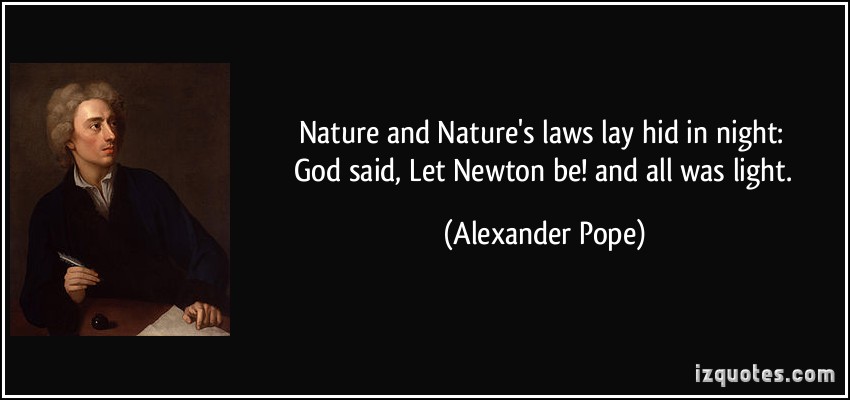
Jesuits tell the Church that Newton is right and the game’s over
Doesn’t challenge, PROVES.
Loss
Not center of universe anymore
1500 years of ignorance
Faith changes
Loss of innocence (like realizing Santa isn’t real)
God becomes known as The Great Watchmaker—God set the universe in motion but does not intervene.
Gain
Gives way to deists
New S.T.E.M. learning and better scientific method
Religious toleration
Better education
Deeper understanding of nature
THE EFFECTS
I. Science becomes mathematical and demands logical, provable explanation.
Epistemology becomes the theory of how to obtain and verify knowledge—experience, reason, and doubt over unsubstantiated authority → Scientific Method.
II. The question: Which was more significant? Loss or gain? Optimism or pessimism?
Battle of Ancients vs. Moderns.
Francis Bacon: induction (specific → general). Supported scientific thinking. New Atlantis (1627).
René Descartes (1596–1650): applied scientific method to knowledge → modern philosophy.
Deduction (general → specific)
Principle of Doubt. “I think therefore I am.”
Invented Cartesian plane, analytic geometry
Discourse on the Method (1637)
Newton + Bacon + Descartes → Scientific Method
Collect data (induction) → hypothesize → experimentation (deduction)
Blaise Pascal: mathematician; after 1654 mystical experience, focused on faith.
Pensées: “The heart has its reasons that reason cannot know.”
III. Marin Mersenne builds scientific correspondence networks → Royal Society of London (1660).
Art and Literature
Mannerism
Esoteric, artificial images, weird perspective, distorted figures, unnatural colors.
El Greco (1541–1614): Greek painter, mannerist.
Michel de Montaigne (1533–1592): created the essay.
Neostoicism: self-knowledge, passive acceptance (Justus Lipsius).
Miguel de Cervantes: Don Quixote, satire.
William Shakespeare (1564–1616).
Return of Assurance: The Baroque
A style of grandeur and opulence, opposing mannerist uncertainty.
Caravaggio starts Baroque.
Baroque characteristics:
Pronounced light and shadow
Subdued color
Motion and emotion
Secular themes
Dimensional play
Dramatic moments
Must-Know Baroque Works (Mr. Houser):
Calling of Saint Matthew
Judith and Holofernes (Caravaggio & Artemisia Gentileschi)
David (Bernini / Michelangelo / Donatello comparison)
The Ecstasy of Saint Theresa (Bernini)
Saint Peter’s Basilica (Bernini finishing vs. Michelangelo building)
Rape of the Sabine Woman (Peter Paul Rubens)
Saint George and the Dragon
Girl with a Pearl Earring (Vermeer)
Baroque splits into Catholic Baroque (ornate, dramatic) and Dutch Baroque (domestic scenes).
Music
New instruments (keyboard, strings).
Opera rises.
Claudio Monteverdi (1567–1643), Orfeo (1607).
Classicism and Dutch Style
Classicism: Baroque detail/drama with restraint and structure.
Nicolas Poussin (1594–1665).
Dutch Style: shaped by Protestantism and republicanism.
Rembrandt van Rijn (1606–1669).
French theater:
Pierre Corneille, Le Cid (1636), condemned by Richelieu.
Jean Racine (1639–1699).
Social Patterns and Popular Culture
I. Population fluctuations: rise in 16th c., decline in 17th c.
II. Status determinants shift to wealth & education.
Women still limited but Artemisia Gentileschi and Aphra Behn show new talent roles.
III. Peasant taxes rise; landowners increase demands (seigneurial reaction).
Famine + war affect lower classes.
Cities and crime rise. Torture common in courts.
IV. More royal officials.
Village life declines; many migrate to cities.
Urban literacy rises (⅓ of men literate by 1700).
V. Belief in magic and rituals → chaos.
Magic used for remedies, omens everywhere.
Great Witch Craze mainly in Central Europe.
After the Scientific Revolution → rise of political change debates (Absolutism)
Key figures: Thomas Hobbes and John Locke
Thomas Hobbes
From poor family, tutor to aristocrats, used scientific logic to study politics.
Secretary to Bacon; mathematician for Charles I.
The Leviathan (1651): people are selfish/ambitious → perpetual war → state of nature
Radical nominalist; everything explained through appetite and aversion
War of All against All → only government can restrain
Social contract: created to avoid the state of nature
Fear keeps order → create a powerful authority → the Leviathan
Supports absolutism based on self-interest.
John Locke
Quiet Oxford scholar; admired Hobbes but disagreed.
Mind at birth = tabula rasa (blank slate).
Reason teaches patterns; all men created equal.
Essay Concerning Human Understanding (1690); Two Treatises of Government (1689)
Knowledge = perception + reflection
Social contract: people are neutral, not bad; must respect life, liberty, property
Morality exists (vs. Hobbes).
Two-step contract → government + sovereign community
Right to Revolution if government breaks the contract
Separation of power and checks & balances
Jefferson heavily borrows Locke’s ideas.
Units
- Preface
- Pre-Renaissance
- The Renaissance & Reformation
- Wars of Religion, New Monarchs, 17th C England
- Scientific Revolution, Art, Locke & Rousseau
- Absolutism, European Balance of Power
- The Enlightenment, New Economics, Cultural Change
- The French Revolution & Reign of Terror
- Napoleonic Era, Congress of Vienna, Concert of Europe
- Age of Metternich, Nineteenth Century
- Threat of Knowledge & WWI
- Interwar Period, and WWII to post-Cold War
Latest Updates
Thanks for using AP Euro Guide.
Keeping a website up and running is not free for us. Many hours of work were put into creating the guide, as well as setting up and funding this website. Consider donating a dollar to keep our guide available and online. Go to our homepage, and click on the “Donate” button.