AP European History Guide
A comprehensive study tool for acing European history and getting a 5 on your exam
Wars of Religion, New Monarchs, 17th C England
War and Crisis
Topics:
Wars of Religion
The Military Revolution
Rivalry of the Past: Philip II
Revolution in England
Political Changes Amidst Crisis
(Does not include the Age of Exploration—covered in World History)
Wars of Religion
Schmalkaldic League
Round 1 (1546–1547) ends with Peace of Augsburg, giving German princes a choice between Lutheranism and Catholicism.
French Civil War Round 2 (1562–1589)
Henry II (1547–1559) marries Catherine de Medici. Son of Francis I (who sided with Protestants in Schmalkaldic War). Holds the church in check. Dies in a jousting contest, leaving three sons (Francis II (1559–1560), Charles IX (1560–1574), Henry III (1574–1589)) under Catherine’s influence. Catherine is the real power.
Calvinism spreads in France → Huguenots are 1/12 of the population → civil war between Catholics and Protestants.
Key leaders:
Henry Guise – Catholic League
Henry Bourbon – Huguenots/Calvinists
Catherine and sons favor Guise but distrust his ambitions. Catherine marries a daughter to Henry Bourbon in 1572 to calm Protestants. Guise advises killing Protestants at the wedding.
St. Bartholomew’s Day Massacre (1572): 2,000 Protestants killed on August 23, 6,000 more within the week. Henry Bourbon promises to convert to Catholicism, escapes to Navarre, stays safe.
War of the Three Henrys – Guise, Bourbon, and Henry III
Guise wants Henry III dead; Henry III wants Guise dead. Both assassinations succeed.
Henry Bourbon becomes Henry IV (1589–1610), converts to Catholicism: “Paris is well worth a Mass.”
Issues Edict of Nantes → religious toleration for Protestants, allows 100 fortified towns.
Henry IV is a “politique” → politics over religion.
Thirty Years War Round 3 (1618–1648)
Largest religious war; arises from German complaints over Peace of Augsburg and religious freedom. Kills 1/3 of German population.
Phase I: Bohemian (1618–1621)
Holy Roman Empire wins.
Ferdinand II elected emperor, wants to revoke religious tolerance.
Defenestration of Prague (1618): two Catholic ministers thrown out of a window, survive.
Maximilian of Bavaria leads the Catholic onslaught.
Phase II: Danish/Lutheran (1621–1630)
Catholics win again.
Duke of Wallenstein leads army.
Edict of Restitution (1620) restores Catholic lands lost since 1555.
Phase III: Swedish (1630–1632)
Gustavus Adolphus, Protestant military genius, turns war around.
Phase IV: End (1632–1648)
France and Sweden win; Spain, Holy Roman Empire, and Germany lose.
Cardinal Richelieu (France) sides with Protestants for political reasons.
Treaty of Westphalia (1648):
Ends war, fragments Holy Roman Empire → delays unification 200+ years.
France gains Alsace and Lorraine.
Sweden gains Holy Roman Empire territory.
Habsburgs lose power; United Provinces and Swiss Confederation recognized as independent.
German princes gain autonomy.
Rise of Brandenburg-Prussia and absolutism.
The Military Revolution
Weapons and Tactics
Gunpowder used extensively → castles vulnerable, expensive sieges.
Spanish: infantry in squares with pikes and gunners, replacing cavalry charges.
Squares: ~3,000 troops; Spain fields 40,000 soldiers per campaign.
Maurice of Nassau: mobility and flexibility focus.
Gustavus Adolphus: salvo (all muskets fire at once).
Organizing Armies and a Soldier’s Life
Army sizes: Spanish 40–60k, Swedes 150k by 1632, Louis XIV 400k by 1700.
Adolphus introduces conscription → standing armies, training, uniforms, officer ranks.
Taxes increase; peasant burden rises.
Recruitment: village quotas, bribery, kidnapping, drunkards; wives/children accompany troops as support.
Medical care is poor.
POPULAR HISTORICAL INTERPRETATION
French Civil War: political motives dominate. Henry Bourbon converts, Catherine marries daughter strategically, Guise and Henry III kill each other, Edict of Nantes legalizes Calvinism.
Thirty Years War: Ferdinand II attempts Catholic unification; Gustavus Adolphus and foreign powers intervene for political reasons. Treaty of Westphalia focuses on land and sovereignty.
BACKGROUND / Rivalry and War in the Age of Philip II
Charles V splits empire: Spain → Philip II, Holy Roman Empire → Ferdinand I.
Philip II (1556–1598) marries Mary I of England (“Bloody Mary”).
Goals: expand empire, defend Catholicism.
Naval victory at Lepanto (1571).
Dutch Revolt: Philip suppresses Calvinists; Duke of Alba executes thousands (Council of Blood).
United Provinces formed from 7/17 provinces.
Spanish Armada (1588) fails against England.
England
Religious tension post-Henry VIII: Protestant Edward VI, Catholic Mary I.
Elizabeth I (1558–1603): politique, restores Anglican Church (Elizabethan Settlement): priests marry, sermons in English, bishops retain robes.
Executes Mary, Queen of Scots (1587).
Succeeded by James I → beginning of Stuart dynasty.
Comparing Elizabeth I and Isabella I of Castile
Both unify countries but with different policies.
Isabella: devout Catholic, religious unification, economic harm.
Elizabeth: politique, Protestant, cultural golden age, economic growth.
Revolution in England: The 17th Century
Core issue: Divine Right vs. Representative Principle, High Church vs. Low Church (Puritans), King vs. Parliament.
Power base: Gentry (~5% population, 20,000 people), hold land, offices, trade, colonial interests → threaten monarchy.
Stuart Monarchy and Interregnum follow.
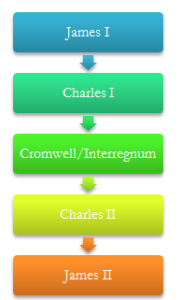
James VI of Scotland aka James I of England (1603-1625)
Upon becoming king, he is greeted with the Millenary Petition, drafted by one thousand Puritan ministers. It asks James to move Anglicanism farther from Catholicism and reduce popery. One result is the creation of the King James Bible.
The Gunpowder Plot is a Catholic plot to assassinate members of Parliament and the king—its discovery raises sentiment against Catholics.
Supporting war efforts in the Dutch Provinces and Ireland during Elizabeth’s reign leaves James with a ₤400,000 debt.
Writes True Law of Free Monarchy, claiming monarchs have indisputable power because they are chosen by God. He claims the king is God’s lieutenant on Earth, so he will rule absolutely with divine right. Going against the king is considered blasphemy.
Power of the Purse—gentry controls the money; James needs taxes but cannot levy them without Parliament’s consent.
Puritans and low-church Anglicans want him to remove bishops, but he fears “no bishop, no king.” As king, he is head of the Church of England.
Charles I (1625-1649)
Charles I wants war with Spain but needs Parliament for financing. Parliament uses the power of the purse to force him to sign the Petition of Right (1628):
-
Limits king’s rights
-
No forced loans
-
Habeas corpus
-
No quartering of troops
-
Due process of law
-
No taxation without Parliament’s consent
-
Tonnage and Poundage (custom duties for one-year only)
Charles breaks the Petition and dissolves Parliament for 11 years—the Eleven Years Tyranny (1629-1640).
Major issues during this time:
-
Ship Money tax extended to inland towns
-
Death of John Elliot, a Puritan, in jail
-
William Laud, Archbishop of Canterbury, enforces high-church Anglicanism
-
Imposes Anglican prayer book on Scots → rebellion
Short Parliament (1640) refuses funds, dismissed after two weeks. Long Parliament (1640-1653) passes:
-
Bill of Attainder against Earl of Strafford and Laud
-
Parliament cannot be dissolved by king
-
Triennial Act: Parliament must meet every 3 years
-
Star Chamber abolished
Charles refuses the Nineteen Propositions → English Civil War (1640-1649):
Phase I (1642-1645): Cavaliers (king) vs. Roundheads (Parliament)
-
Oliver Cromwell leads Roundhead army → defeats Cavaliers
Phase II (1645-1647): New Model Army purges Long Parliament → Rump Parliament
Phase III (1647-1649): Scots, Irish, and Charles I rebel → defeated by Cromwell
-
Charles I tried and executed January 30, 1649
Oliver Cromwell and the Interregnum (1649-1660)
-
Opposed radical sects like Levellers and Diggers
-
Forms Protectorate with 12 military districts (1653)
-
Becomes Lord Protector, builds army/navy, intolerant of Catholics, Anglicans, atheists
-
Rules under martial law until 1658 → succeeded by son Richard
-
1660: Parliament restores monarchy → Charles II
Charles II and the Restoration (1660-1685)
-
Executes Cromwell’s corpse to assert authority
-
Returns monarchy → Puritans lose control, Anglican Church restored
-
Clarendon Code enforces Anglican supremacy
-
Treaty of Dover (1670): secret deal with France → Charles will convert to Catholicism, France gives money and troops
-
Declaration of Indulgence (1672): suspends anti-Catholic laws → Parliament forces retraction
-
Test Act (1673): prohibits non-Anglicans from public office
-
Popish Plot (false) stirs anti-Catholic sentiment
-
Exclusion Crisis (1681): prevents James II from throne → Whigs vs. Tories
James II (1685-1688)
-
Tries to Catholicize army and universities
-
Uses dispensing power to override laws
-
Duke of Monmouth rebellion → defeated, Bloody Assize follows
-
Declaration of Indulgences read in churches → trial of Seven Bishops
-
Parliament waits for Protestant daughter Mary → married to William of Orange
-
1688: James’ son born → threat of Catholic dynasty
-
Glorious Revolution: William and Mary invited → James flees, no bloodshed
William and Mary (1689-1702)
-
Parliament declares James II abdicated → co-monarchs
-
Bill of Rights (1689): limits monarch’s power, Parliament supreme
-
Suspension of laws or taxation without Parliament illegal
-
Freedom of election, free speech, no excessive bail, quartering troops forbidden
-
Act of Toleration (1690): religious freedom except for Catholics
-
Battle of Boyne (1690): William defeats James II
-
Mutiny Act (1689): army under Parliamentary control
-
Act of Union (1707): unites England and Scotland → Great Britain
Crises Elsewhere
France:
-
Henry IV strengthens royal power, supports Nobles of the Sword and bureaucracy (Nobility of the Robe)
-
Assassinated in 1610, leaves strong economy and mercantilist policy
-
Louis XIII (9 years old) ruled under mother Marie de Medici → Estates General meets 1614
-
Cardinal Richelieu centralizes power, curbs nobles, controls Huguenots
-
The Fronde (1648-1652): failed revolt against royal authority
Spain:
-
Philip II’s empire strained → bankruptcies, heavy taxation
-
Philip IV’s minister Count of Olivares → Union of Arms fails
-
Catalonia and Portugal revolt in 1640
Holland:
-
Dutch Republic thrives → Amsterdam becomes financial capital
-
Schism: Holland/Zeeland vs. House of Orange
-
Maurice of Nassau executes political rivals
Sweden:
-
Gustavus Adolphus modernizes army and bureaucracy
-
Domestic economy: copper and iron industries
-
Christina abdicates 1654 → Charles X succeeds, Riksdag maintains weak representation
Popular Historical Interpretation
-
James I: divine right aggravated Parliament → failed Machiavellian
-
Charles I: poor judgement, 11 Years Tyranny → disliked, failed ruler
-
Cromwell: strong militarily, autocrat from Parliament, strengthened Britain’s army/navy
-
Charles II: Machiavellian, “Merry Monarch,” compromised with Parliament, secret Catholic sympathies
-
James II: not Machiavellian, overreach fails → Parliament prevails
Why Parliament Won:
-
Skillful use of prerogatives (esp. power of the purse)
-
Poor judgement of Stuart monarchs
Units
- Preface
- Pre-Renaissance
- The Renaissance & Reformation
- Wars of Religion, New Monarchs, 17th C England
- Scientific Revolution, Art, Locke & Rousseau
- Absolutism, European Balance of Power
- The Enlightenment, New Economics, Cultural Change
- The French Revolution & Reign of Terror
- Napoleonic Era, Congress of Vienna, Concert of Europe
- Age of Metternich, Nineteenth Century
- Threat of Knowledge & WWI
- Interwar Period, and WWII to post-Cold War
Latest Updates
Thanks for using AP Euro Guide.
Keeping a website up and running is not free for us. Many hours of work were put into creating the guide, as well as setting up and funding this website. Consider donating a dollar to keep our guide available and online. Go to our homepage, and click on the “Donate” button.